Effective Maker Education must move from assembly-line kits to a concepts-first approach, where students apply scientific principles to solve open-ended design challenges, as we discover in an interview with maker learning innovator, York Su. This approach intentionally creates productive struggle, the optimal learning zone, which research shows is essential for building resilience and student agency. To manage this pedagogical shift, teachers must act as facilitators, while classroom technology serves to make individual micro-discoveries visible to the collective group.
There is a distinct psychological difference between assembling a piece of pre-cut furniture and designing a table from scratch. One is an exercise in following instructions, while the other is an engineering challenge.
In education, this distinction is crucial. While Maker Education aims to reshape how students learn through hands-on projects, too many programs have fallen into the trap of the assembly line: perfectly packaged kits that guarantee success, provided the student follows every step of the instructions.
At EdTech Taiwan 2025, conversations around maker kits underscored how easy it is for well-intentioned resources to tip from creative tools into step-by-step templates.
If finishing the kit is framed as the goal, are students actually learning to think like designers?
According to York Su, CEO of Taiwan-based maker learning company WeClass, the answer is often no. True learning happens in the friction — the moments where the manual ends and the student’s own logic begins. In a recent interview, Su shared his philosophy on moving from rote assembly to “concepts-first” creation and why the classroom of the future needs to be a little less predictable.
Shifting from Kits to Concepts-First Maker Learning
“The ethos of maker learning is about starting to create something from scratch, not being given a kit and just simply assembling it,” Su explains. He notes that in Taiwan, many educational kits historically originated from tool or machine manufacturing companies. The resulting pedagogy often mirrored a factory floor: efficiency and replication were the goals.
However, the modern workforce needs more problem-solvers, not just assemblers. Research supports this shift1: studies on open-ended play and learning indicate that explicit, rigid instructions can limit a child’s creativity and scientific discovery. Instead of building first and hoping understanding follows, a more productive model introduces a scientific concept, such as torque or friction, and then tasks students with building a mechanism to demonstrate it.
This concepts-first approach aligns with Seymour Papert’s theory of Constructionism2, which argues that learning happens best when students build external artifacts. Papert emphasized that the building process must support the construction of mental models, not just physical ones.
It is also in tune with the goals of STEAM education (Science, Technology, Engineering, Arts, and Mathematics), emphasizing deep, conceptual understanding over mere procedural replication.
Furthermore, inquiry-based learning integrates well with Project-Based Learning (PBL), which has been shown to significantly improve students’ academic achievement and higher-order thinking skills compared to traditional methods3. It simulates a real-world environment where you bring skills to a project, solve unique problems, and move on.
Using Productive Struggle to Build Student Resilience
One of the central elements of maker learning is productive struggle, the “sweet spot” where a task is difficult enough to challenge a student but not so overwhelming that they give up.
“Struggle leads to the realization that you haven’t learned enough and must learn more to proceed,” says Su.
He illustrates this with a story of two brothers competing in a sumo robot battle during his maker class. One brother’s robot kept losing. Instead of buying a more powerful motor (a consumer solution), he analyzed the physics of the defeat and realized his robot lacked traction. His solution was to apply a rubberized texture to the wheels by using a glue gun to increase friction, winning a rematch and internalizing a physics concept through failure.
When students engage in tasks that are just beyond their current mastery, supported by opportunities to iterate, they build resilience and agency — the belief that they can influence their own learning. The OECD’s Future of Education and Skills 2030 project4 highlights student agency as a core competency, defining it as the capacity to set goals, reflect, and act responsibly to effect change.
Consequently, the teacher’s role must shift from being a “fixer” to a “safety net.” Teachers must provide high-level direction and resist the urge to solve every problem, allowing students autonomy to navigate the necessary struggle. This pedagogical restraint is difficult but necessary. “Rescuing” a student too early undermines the learning process.
This focus on unique, student-led solutions creates a logistical challenge for teachers. If thirty students are building thirty different variations of a robot, how does a teacher coach the class?
That’s where the right hardware becomes a partner to the curriculum. John Hattie’s research on Visible Learning5 argues that student thinking must be apparent to the teacher and peers to be effective. In a maker lab, this requires visual accessibility.
Educational technology tools, such as visualizers (document cameras) and Auto Tracking Cameras, can serve as the bridge between individual discovery and collective learning. In the case of the sumo robot cited above, a teacher using a visualizer can instantly project the student’s modified wheels onto the main classroom screen/Interactive Flat Panel (IFP) so the entire class can zoom in on why it works. The device turns a solitary “aha!” moment into a class-wide lesson on material science.
What’s more, maker learning is dynamic. Things move, crash, and fall over. Su recounts another student who programmed a floor-sweeping robot to “shake its head” whenever it couldn’t find trash — a touch of personality that wasn’t in the manual. Using Auto Tracking Cameras, teachers can record these robot runs. This creates a recorded video that students can review later, analyzing their coding logic or mechanical failures without the immediate pressure of the live performance. It turns the classroom into a design lab where iteration is documented and celebrated.
Building Minds, Not Just Kits
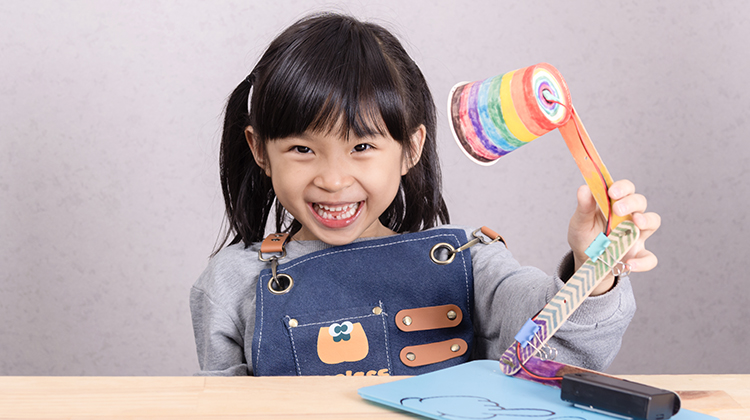
The “IKEA Effect,” which refers to the tendency to place high value on things we have built ourselves, is powerful in education. The goal must be to ensure students are building with their minds, not just their hands.
As York Su demonstrates, the most effective learning environments are those that welcome friction, failure, and original design. To make this practical in a busy classroom, educators need tools that support visibility and reflection. Whether it is a curriculum that asks “why?” before “how” or a camera that magnifies a student’s tiny engineering breakthroughs, the goal remains the same: to move beyond the instruction manual and get to the real work of learning.
Frequently Asked Questions
What is “concepts-first” maker learning?
Instead of following a manual, students learn a scientific principle and then build a project to show how it works. This method focuses on building mental models rather than just assembling parts.
How do difficult tasks help students learn?
Learning happens best in the “sweet spot” where a project is challenging but still possible to finish. This balance helps students build resilience and the confidence to take on and solve problems.
What is the teacher’s role in maker education?
The teacher acts as a guide and a “safety net” rather than a “fixer.” They give high-level direction but allow students to navigate their own technical hurdles.
How does a visualizer help the entire class?
A visualizer (document camera) projects a specific student’s unique solution or “aha!” moment onto a shared screen. This turns an individual discovery into a collective lesson for everyone to study and learn.
Why record student projects with Auto Tracking Cameras?
Since iteration is an important part of STEAM and maker learning, recording allows students to review their work later to see why a design succeeded or failed. It lets them analyze their logic without the pressure of a live performance.
References
Bonawitz, Elizabeth, Patrick Shafto, Hyowon Gweon, Noah D. Goodman, Elizabeth Spelke, and Laura Schulz. 2011. “The Double-edged Sword of Pedagogy: Instruction Limits Spontaneous Exploration and Discovery.” Cognition 120 (3): 322–30. https://doi.org/10.1016/j.cognition.2010.10.001. ↑
Kretchmar, Jennifer. 2021. “Seymour Papert and Constructionism.” Research Starters, EBSCO Research. https://www.ebsco.com/research-starters/religion-and-philosophy/seymour-papert-and-constructionism. ↑
Terada, Youki. 2021. “New Research Makes a Powerful Case for PBL.” Edutopia. February 21, 2021. https://www.edutopia.org/article/new-research-makes-powerful-case-pbl. ↑
OECD. 2019. “Student Agency for 2030.” https://www.oecd.org/content/dam/oecd/en/about/projects/edu/education-2040/concept-notes/Student_Agency_for_2030_concept_note.pdf. ↑
“Visible Learning: A Synthesis of Over 800 Meta-Analyses Relating to Achievement.” 2009. Routledge & CRC Press. https://www.routledge.com/Visible-Learning-A-Synthesis-of-Over-800-Meta-Analyses-Relating-to-Achievement/Hattie/p/book/9780415476188. ↑