ICUs are meant for healing, but constant alarms and noise make recovery harder. For hospital decision-makers and system integrators, the “Silent ICU” is an automated system aiming to change that by combining smart alerts with visual verification — a qualitative assessment only achievable with realistic live video — for a quieter, safer care environment.
The Intensive Care Unit (ICU) is the hospital’s most technologically advanced and critical setting, yet it harbors environmental challenges that actively impede patient recovery and staff performance. At the forefront of these issues are excessive noise and alarm fatigue. In many critical care wards, sound levels frequently hover between 55 and 70 dBA, which is significantly higher than the World Health Organization’s (WHO) recommendation of 30 dBA1.
One study noted that average sound levels in UK adult ICUs exceeded 45 dBA, with averages often reaching between 52 and 59 dBA2. This relentless acoustic environment contributes directly to sleep deprivation and is strongly associated with higher rates of ICU delirium, a serious cognitive impairment linked to prolonged hospital stays, increased mortality, and poorer long-term outcomes for patients3.
At the same time, the deluge of electronic signals creates the phenomenon of alarm fatigue. Clinical alarms are designed to warn staff of potential dangers, but they are overused. Studies suggest that more than 80% of clinical alarms generated by patient monitoring systems are either technically false (e.g., a motion artifact) or clinically irrelevant and non-actionable4. This sensory overload causes staff desensitization, or the “cry-wolf” effect, which leads to slower response times and, in the worst cases, critical alarms being missed entirely.
Bridging the Gap from Alerts to Contextual Confirmation
The industry is responding with a necessary shift. New standards, exemplified by the future direction of IEC 60601-1-8:2020, anticipate a move toward silent, targeted Distributed Alarm Systems (DAS). This fundamentally changes how warnings are delivered. They replace the widespread, loud broadcast of alarms with targeted mobile alerts sent only to the responsible clinical team, and so preserve the quietness of the ICU for the patient.
That said, a critical flaw remains: an electronic alert, regardless of the device it is sent to, lacks the necessary clinical context. A monitor may signal a critical parameter violation, but the clinician still needs to verify the patient’s condition. Is the low oxygen saturation reading real, or did the sensor slip? Has the patient simply shifted position, or are they experiencing acute respiratory distress?
That uncertainty forces nurses to make frequent bedside trips. Combining a typical 1-3 minute walk/triage plus 1-2 minutes of bedside assessment translates to 2-5 minutes spent per unnecessary alarm. Multiplying this lost time by the hundreds of alarms triggered daily across a unit reveals a massive drain on nursing resources.
The Power of Visual Confirmation
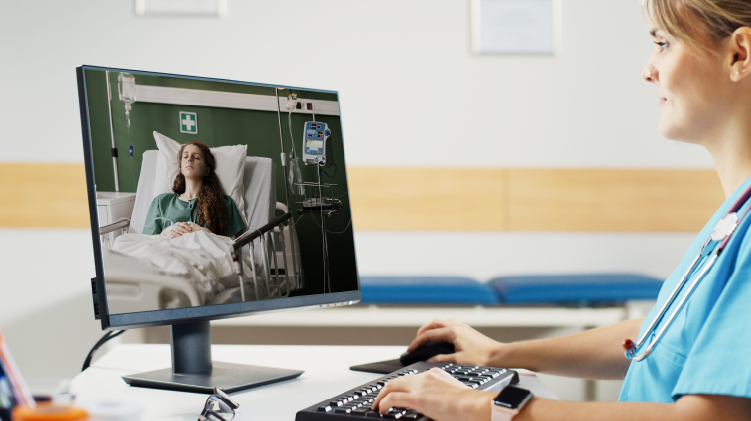
What this implies is the need for a solution that enables visual confirmation but without the travel time. Such an approach would use an automated, secure workflow to connect the nursing call system to a medical grade camera through APIs.
This process enables an instantaneous visual check:
- Patient monitor triggers an alarm threshold violation.
- The nursing call system sends a targeted alert to the assigned clinician’s device.
- For a brief period, the camera’s default privacy feature is temporarily and securely disabled.
- Automatically, the Pan Tilt Zoom (PTZ) camera moves to a pre-programmed bed view and initiates a secure, low-latency video stream.
- The clinician views the live feed on their device, confirms whether the alarm is actionable based on the patient’s facial expressions, skin tone, and other real behaviors that physiological monitors cannot register. The PTZ functionality allows zooming in for close-ups, providing the necessary context to determine if immediate intervention is needed, and therefore eliminating an unnecessary trip to the room.
Operational Efficiency and Quality Outcomes
Visual verification provides significant benefits that enhance the quality of patient care and strengthen the hospital’s economic resilience.
Reclaiming Nursing Hours
By providing the contextual information needed for remote triage, visual confirmation systems can dramatically reduce the need for in-person checks to confirm nuisance alarms. If this system eliminates just 20% of unnecessary response trips, it translates into hundreds of hours of saved nursing time per month for a busy critical care unit. This frees up the nursing staff to focus on direct, high-value patient care tasks instead of being tethered to a system that constantly cries wolf.
Positive Impact on National Quality Metrics
In the U.S., hospital quality is intrinsically tied to financial reimbursement through programs administered by the Centers for Medicare & Medicaid Services (CMS). Visual verification directly addresses elements of two key programs:
- CMS Hospital-Acquired Condition (HAC) Reduction Program: Better, immediate visual assessment allows clinicians to prevent patient deterioration and quickly address potential issues before they become serious adverse events. Avoiding these eventswould generally contribute to a lower HAC score. Hospitals performing in the worst-performing quartile of the HAC Reduction Program face a statutory 1% payment reduction on their total Medicare fee-for-service payments for the fiscal year5. By assisting staff efficiency and rapid response, this system helps prevent conditions that lead to these costly penalties.
- HCAHPS (Hospital Consumer Assessment of Healthcare Providers and Systems): The HCAHPS survey measures patient experiences, with questions focused on communication and the hospital environment. Crucially, HCAHPS includes items related to the hospital environment (cleanliness and quietness)6. Reducing the total number of alarms and in-person room checks, especially at night, significantly contributes to the patient’s perception of nighttime tranquility and noise management. Improved scores on this patient experience metric can positively influence a hospital’s performance in the Hospital Value-Based Purchasing Program (VBP), ultimately affecting overall CMS reimbursement.
Auditable Records and Liability Considerations
A visual record provides auditable video data that can be utilized for continuous quality improvement initiatives, such as analyzing alarm response workflows or identifying common root causes of alarms. While the use of video in patient rooms sometimes raises initial privacy and liability concerns among nurses, the system is designed for care quality analysis and objective record-keeping. It is a tool for systemic improvement and better patient outcomes, not a punitive measure for individual fault.
Visual-First Critical Care Implementation
| Stakeholder Requirements |
| Stakeholder |
Primary Focus |
Key Requirements |
| System Integrators & Software Providers |
Automated Workflow & Performance |
• Performance: Sub-second streaming and instant API control for PTZ cameras.
• Coverage: One high-resolution camera deployed per bed.
• Compliance: Strict adherence to medical grade hardware standards, video security, access control, and default-to-privacy systems.
|
By partnering with AVer’s open APIs and Medical Grade Camera technology, the healthcare sector can deploy the infrastructure needed to realize a quieter, safer, and more efficient era of critical care. Discover AVer’s connected health solutions, like the MD330UI, or contact our sales team to discuss a tailored deployment.
Frequently Asked Questions
How does false alarm reduction improve the healing environment?
Critical care noise often exceeds the WHO’s 30 dBA recommendation, causing sleep deprivation and higher rates of ICU delirium. By implementing silent, targeted alerts and reducing unnecessary in-room checks, the system helps achieve tranquility.
What context does visual confirmation add beyond existing monitoring data?
Monitors signal threshold violations, but lacks the context needed to confirm if the alert is real (e.g., sensor slip or true distress). Visual confirmation shows real patient behaviors (facial expressions, skin tone, positioning, etc.). The camera’s PTZ function allows zooming in to confirm the status for more effective remote triage.
How much time can nurses save using this system?
Studies suggest over 80% of alarms are non-actionable. With an estimated 2-5 minutes lost per unnecessary bedside check, eliminating just 20% of these trips translates into hundreds of saved nursing hours monthly. This frees staff to focus on direct, high-value patient care tasks.
How are patient privacy and liability concerns addressed?
Privacy is secured through systems that default to a private mode. This feature is only temporarily and securely disabled when an alarm requires visual confirmation. The system provides auditable video data for continuous quality improvement, such as analyzing alarm response workflows, and serves as an objective record for systemic improvement.
References
Environment, Climate Change and Health (ECH). 1999. “Guidelines for Community Noise.” February 10, 1999. https://www.who.int/publications/i/item/a68672. ↑
Darbyshire, Julie L, and J Duncan Young. 2013. “An Investigation of Sound Levels on Intensive Care Units with Reference to the WHO Guidelines.” Critical Care 17 (5). https://doi.org/10.1186/cc12870. ↑
Kamdar, Biren B., Dale M. Needham, and Nancy A. Collop. 2011. “Sleep Deprivation in Critical Illness.” Journal of Intensive Care Medicine 27 (2): 97–111. https://doi.org/10.1177/0885066610394322. ↑
Cvach, Maria. 2012. “Monitor Alarm Fatigue: An Integrative Review.” Biomedical Instrumentation & Technology 46 (4): 268–77. https://doi.org/10.2345/0899-8205-46.4.268. ↑
“Hospital-Acquired Condition Reduction Program | CMS.” https://www.cms.gov/medicare/payment/prospective-payment-systems/acute-inpatient-pps/hospital-acquired-condition-reduction-program-hacrp. ↑
“HCAHPS: Patients’ Perspectives of Care Survey | CMS.” https://www.cms.gov/medicare/quality/initiatives/hospital-quality-initiative/hcahps-patients-perspectives-care-survey. ↑