Collaborative Online International Learning (COIL) helps schools and universities create meaningful global learning experiences without the cost and logistical barriers of travel. By combining structured social connection, cross-cultural exchange, and real-time collaborative projects, educators can help students co-learn and build relationships with peers worldwide. With reliable video, audio, and content-sharing technology, institutions can turn occasional virtual exchanges into engaging, borderless classrooms.
International cooperation between schools and universities is still the exception, not the norm, yet it is becoming increasingly important for preparing learners for a globalized world. Most institutions want their students to work with international peers, but costly travel, time‑zone conflicts, and basic video setups often keep those plans on the wish list, not the timetable.
Collaborative Online International Learning (COIL), a methodology born in higher education and now spreading into secondary schools, offers a practical way to move beyond one‑off virtual visits toward sustained, project‑based collaboration. Instead of treating online exchanges as occasional event, COIL encourages educators to design shared assignments where students co‑learn, co‑create, and build genuine relationships across continents. To make that vision work in everyday classrooms and lecture halls, institutions need both the right teaching model and a reliable technical blueprint — video, audio, and content‑sharing tools that make a cross‑border session feel as natural as teaching in the room next door.
Strategy 1: Building Student-to-Student Social Connection
Impactful academic collaboration does not start with the syllabus; it starts with students feeling safe and curious about each other. When learners only meet in formal, teacher‑controlled sessions, they tend to stay quiet, worry about making mistakes, and default to “presenting” instead of truly working together.
To lower that barrier, instructors can plan structured social ice‑breakers before and alongside academic tasks. Simple, repeatable activities, such as two‑minute self‑introductions, “show and tell” with objects from daily life, or short breakout‑room games, can give students permission to relax and communicate with lower stakes. Themed school events such as “a day in my major” can connect directly to the course topic while staying informal.
Technology also plays a subtle but important role. When audio cuts out or cameras freeze, students quickly retreat and leave the conversation to the confident few. A stable video setup, clear classroom audio, and camera views that show both faces and body language help remote peers feel present in the same space, so those ice‑breakers actually do their job and open the door to deeper collaborative work.
Strategy 2: Building Students’ Cultural Understanding
When international projects focus only on the task and ignore culture, they often slip into group work via video calling instead of becoming truly transformative. Well‑designed cross‑cultural exchanges help students build empathy and cultural awareness, understanding with more nuance how people think and live in other parts of the world.
A practical way to do this in COIL projects is to make students’ real lives part of the curriculum. Instead of only reading about other cultures in textbooks, students can hear directly from peers about their own traditions, routines, and perspectives. For example, a learner in Taiwan might explain Lunar New Year customs to a classmate in New Zealand, or a student in Germany might describe how their city is responding to a global issue. Everyday interactions like these help students move beyond stereotypes and see global topics through the lens of real people they know.
High‑quality video and audio make these cultural moments more vivid and memorable. Clear images of physical artifacts, documents, or local environments — captured with tools like document cameras or PTZ cameras — help remote partners feel as if they are “in the room,” not just watching another slide deck.
Strategy 3: Embrace Synchronous Co-Learning
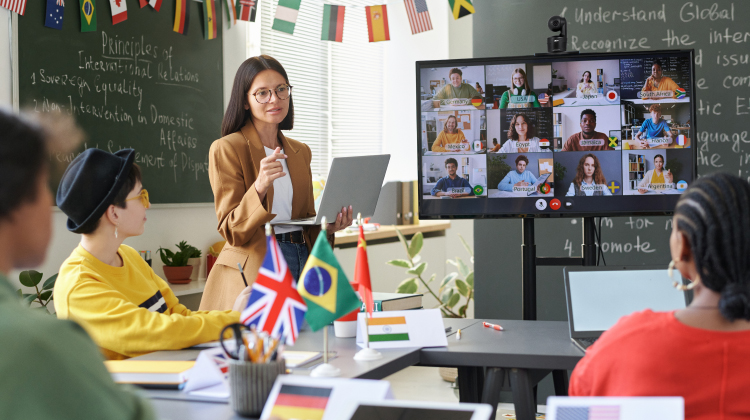
Many international “online exchanges” still follow a turn‑taking pattern: one class presents while the other listens, then they swap roles the following week. That format can be useful for sharing, but it rarely feels like true collaboration. The core idea behind COIL is different: students in different locations work on shared objectives at the same time, seeing each other not as an audience but as teammates.
To make this kind of synchronous co‑learning work, design tasks that genuinely require joint effort. Instead of two separate presentations on the same topic, try a single co‑authored report, a shared experiment, or a live debate where mixed teams must build an argument together. For example, two universities could co‑design a marketing case study where mixed teams analyze local brands from each country and present a joint recommendation in a live session. Cloud tools like shared documents, online whiteboards, and collaborative slides let students plan and edit in real time, even if they are in different countries or institutions.
Professional grade video and audio are what keep those joint activities from collapsing into chaos. Reliable cameras that can track speakers, capture the whole room, or zoom in on lab work help both sides stay oriented and engaged. When everyone can clearly see who is talking and what is happening on the other side, synchronous sessions feel less like a “call” and more like a single, borderless classroom where learning is happening together, in the moment.
Turning COIL into Reality with the Right AV Foundation
International cooperation works best when pedagogy and technology are in unison. COIL provides a flexible way to design projects where students don’t just talk once, but co‑learn, co‑create, and build lasting cross‑border relationships. Yet even the strongest teaching model can only go so far if it runs on basic, unreliable tools.
When institutions rely on built‑in laptop webcams and patchy audio, they inevitably limit what is possible in the virtual classroom. Investing in professional AV setups transforms a standard video call into a unified, borderless learning space where everyone can see, hear, and contribute clearly. If you are ready to move from occasional virtual visits to true international co‑teaching, AVer’s Auto Tracking PTZ cameras and visualizers offer a practical backbone for your global classroom blueprint.
References