Anyone searching for an auto tracking PTZ camera is usually standing at one of three different starting points. Some are evaluating equipment for a classroom, boardroom, or place of worship and need to know whether the technology can replace a human camera operator. Others are solo creators or small production teams who want professional-looking footage without hiring a videographer. A third group works in dance studios, skating rinks, gymnastics gyms, or theaters, where the camera needs to follow a performer through continuous, moderate-speed movement rather than sit still on a fixed subject.
This guide pulls all three perspectives together. Instead of treating auto tracking as one generic feature, it walks through how the technology actually works, where it performs well, where it struggles, and what to check before committing to a purchase.
What Is an Auto Tracking PTZ Camera?
A PTZ camera is a pan, tilt, and zoom camera that can be repositioned remotely, either by a human operator using a controller or automatically through software. An auto tracking PTZ camera adds a layer of artificial intelligence on top of that hardware. Instead of waiting for someone to move the camera, the system detects a person or object in the frame and adjusts pan, tilt, and zoom in real time to keep that subject centered and properly framed.
This is different from a fixed wide-angle camera that simply captures everything in its field of view. It is also different from a manually operated PTZ camera, where a technician sits at a joystick controller for the entire session. Auto tracking sits in between: the hardware is the same PTZ camera used in traditional broadcast and AV setups, but the operation is automated.
The technology matters because it removes a recurring labor cost. A classroom does not need a dedicated camera operator every time a lecture is recorded. A solo streamer does not need a second person behind the camera. A dance studio does not need staff pulled away from teaching to film a rehearsal. In each case, the appeal is the same: consistent, hands-free video capture.
Industry consultant takeaway: before comparing specific cameras, define what "automated" needs to mean for your use case. A conference room only needs the camera to follow whoever is speaking. A dance studio needs it to follow continuous movement across a wide floor. Those are different technical challenges even though both fall under the same product category.
How Auto Tracking Technology Works
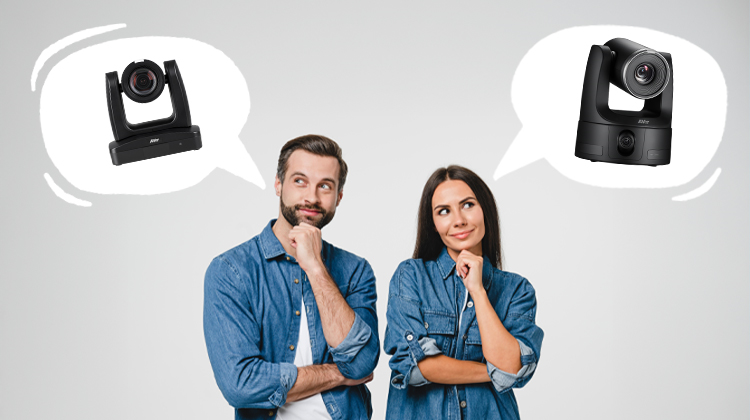
Most auto tracking cameras rely on a combination of computer vision and predictive movement logic. Understanding the basic mechanics helps explain why performance varies so much between use cases.
Subject detection is the first step. The camera identifies a person, typically through face detection, body/shape detection, or a combination of both. Face-based detection tends to be more precise for stationary or slow-moving subjects, such as a presenter standing at a podium. Body-based detection is generally more reliable for continuous movement, since the system does not lose the subject the moment a face turns away from the lens.
Framing logic determines how the camera keeps the subject positioned in the shot. Most systems use a defined region of interest, sometimes called a framing zone, and the camera only moves once the subject drifts toward the edge of that zone. This prevents the picture from jittering every time someone shifts their weight slightly.
Movement prediction is where systems start to diverge in quality. Basic tracking reacts to where the subject currently is. More advanced tracking anticipates where the subject is about to be, which produces smoother pans instead of a delayed, jerky correction. This becomes especially important for subjects that move in curves or spins rather than straight lines.
Zoom stability is a related and often underappreciated challenge. As a subject moves closer to or farther from the lens, the camera has to zoom in real time without overcorrecting. Poorly tuned systems will hunt, zooming in and out repeatedly as they try to lock onto the correct framing.
Multi-person and re-identification logic comes into play whenever more than one person is in frame. The camera needs rules for deciding who to follow, whether that is the loudest speaker in a meeting, the first person detected, or a manually assigned primary subject. Some systems can also re-identify a subject who temporarily leaves and re-enters the frame, rather than treating them as a new, unranked target.
Industry consultant takeaway: when comparing spec sheets, look past the marketing phrase "AI-powered tracking" and ask three specific questions: does it use face detection, body detection, or both; does it predict movement or only react to it; and how does it handle more than one person in frame. These three answers explain most of the performance differences you will encounter in real-world testing.
Key Features to Know Before You Buy
Beyond the core tracking engine, a handful of features determine whether a camera fits a specific environment.
| Feature |
Who It Matters Most To |
What It Affects |
| Broadcast, live streaming, education |
Image clarity, especially when zoomed in |
| Enterprise AV teams, streamers using OBS or Zoom |
How the camera integrates with existing software and hardware |
| Large venues, gymnasiums, stages |
How large an area the camera can cover before losing the subject |
| Performing arts, sports, walking presenters |
Whether the frame leaves natural space in the direction of movement |
| Panel discussions, group rehearsals, interviews |
Whether the camera can widen out to include several subjects |
| Outdoor events, stadiums, exterior installations |
Weatherproofing and lens performance in variable light |
| All use cases, especially live production |
Manual override options when automation is not enough |
Connectivity deserves particular attention for two of the three groups covered here. Enterprise buyers usually need NDI or SDI support to integrate with existing broadcast and conferencing infrastructure. Solo creators and small production teams are more often looking for USB or NDI compatibility with common software like OBS, Zoom, or a streaming platform's native app. If a camera cannot talk to the software you already use, none of its tracking capability matters.
Industry consultant takeaway: build a short checklist before shopping. List the software and hardware you already have (conferencing platform, streaming software, existing cameras or switchers), the size of the space the camera needs to cover, and whether the environment is indoor, outdoor, or both. Filter every camera against that list before comparing tracking quality.
Good Tracking vs Bad Tracking
Not all auto tracking performs the same, and the difference is usually visible within the first few minutes of testing.
Signs of weaker tracking systems include jerky starts and stops, where the camera lags behind the subject and then snaps into position; subject hunting, where the frame drifts or searches when the subject briefly leaves the detection zone; and lost lock, where the camera fails to reacquire the subject after an occlusion, such as someone walking briefly out of frame.
Signs of stronger, more advanced tracking include smooth, curved pans that anticipate direction rather than reacting to it, sometimes described as S-curve motion; dead-zone logic that avoids unnecessary micro-adjustments during small, natural movements; and reliable re-identification that allows the camera to correctly resume tracking the right subject after a brief interruption.
This distinction matters most for the groups whose subjects move continuously rather than staying largely stationary. A presenter standing at a podium is a relatively easy tracking target. A dancer moving through a turn, a skater gliding across a rink, or a gymnast moving fluidly across a floor routine puts far more strain on the prediction and zoom-stability systems described earlier. Cameras that work well for a static speaker do not automatically perform well for continuous, curved movement, so evaluating tracking quality against your actual subject's movement pattern is more useful than trusting a general "auto tracking" label.
Industry consultant takeaway: ask any vendor for footage or a live demo using movement similar to your own use case, not a generic demo of someone walking in a straight line across a stage. A camera that looks smooth tracking a walking presenter can still stutter on a spinning subject.
Conclusion
An auto tracking PTZ camera is not a single, uniform product category. The right choice depends heavily on who the subject is, how they move, and what infrastructure the camera needs to connect with. Enterprise buyers should prioritize reliability, integration, and total cost of ownership. Solo creators should prioritize software compatibility and framing quality within their budget. Studios, coaches, and performance venues working with continuous, moderate-speed movement should prioritize smooth movement prediction and zoom stability over raw tracking speed.
Testing a camera against footage or a demo that actually reflects your subject's movement pattern remains the most reliable way to avoid a mismatch between expectations and real-world performance. Once that fit is confirmed, the remaining decision usually comes down to connectivity, budget, and the level of ongoing support or licensing your environment requires.
Frequently Asked Questions
Can an auto tracking PTZ camera fully replace a human camera operator?
In many stationary or moderately mobile scenarios, yes. For fast, unpredictable, multi-subject environments, a human operator or a hybrid setup with manual override remains more reliable.
Does auto tracking work well for group settings?
It depends on the system's multi-person framing logic. Some cameras can widen the frame to include several subjects, while others are designed to follow a single primary subject and may struggle when several people move independently.
Is auto tracking suitable for dance, skating, or gymnastics recording?
Cameras with strong movement prediction and zoom stability generally handle this well, since the movement, while continuous, tends to follow a predictable path. Basic tracking systems built primarily for stationary speakers may struggle with turns and continuous motion.
What connectivity should I look for?
Enterprise and broadcast environments typically need NDI or SDI support, while individual creators usually prioritize USB or NDI compatibility with common streaming software.
Do these cameras require a subscription?
This varies by manufacturer. Some auto tracking systems are fully self-contained in the camera hardware, while others rely on separate tracking software or a server that may involve licensing costs.
References
- Installation International. "Studies Reveal Importance of New Tech in the Hybrid Workplace." https://www.installation-international.com/business/advertorial/studies-reveal-importance-of-new-tech-in-the-hybrid-workplace.
- NDI. "NDI – Removing the Limits of Video Connectivity." https://ndi.video/.
- Verkada. "What Is a PTZ Camera? Pan-Tilt-Zoom Security Cameras Explained." https://www.verkada.com/blog/what-is-a-ptz-camera-pan-tilt-zoom/.
- viso.ai. 2025. "Revolutionizing Face Detection with AI & CNN Technology." June 25, 2025. https://viso.ai/deep-learning/face-detection-overview/.
- Voelkel, Susanne, Andy Bates, Terry Gleave, Carl Larsen, Elliott J. Stollar, Gemma Wattret, and Luciane V. Mello. 2023. "Lecture Capture Affects Student Learning Behaviour." FEBS Open Bio 13 (2): 217–32. https://doi.org/10.1002/2211-5463.13548.
- Wang, Jianren, and Yihui He. 2020. "Motion Prediction in Visual Object Tracking." arXiv. https://arxiv.org/abs/2007.01120.
- Wikipedia contributors. "Power over Ethernet." Wikipedia. https://en.wikipedia.org/wiki/Power_over_Ethernet.