Taiwanese special education educator Lee Pin-Hsuan explains how multimodal AI can help students with disabilities turn fragmented thoughts, spoken ideas, and creative instincts into meaningful work. Through his four-stage framework — Initiation, Fluency, Application, and Professional — Lee shows how AI can build confidence, support self-expression, and help students direct technology rather than depend on it. The article also follows a powerful case study of a student with ADHD who used AI-assisted conversations to create a comic that revealed his emotional insight and problem-solving ability.
There is a common misconception that using AI requires advanced coding skills or flawless grammar. Yet Lee Pin-Hsuan, a Taiwanese special education pioneer and educator, relentlessly challenges this assumption. As AI enters a multimodal era, where it is capable of communication through voice, images, even occasionally video, students no longer need perfect linguistic or technical abilities to express their ideas. Lee describes AI as a "cognitive scaffold" for special needs students: this system can help capture and organize the thoughts of children who struggle with traditional text-based communication. By acting as an extension of the student's mind, AI empowers those who find writing difficult to document their ideas and revisit their own learning journeys at their own pace.
Lee's insights draw from years of hands-on experience in the classroom, and his approach offers a compelling blueprint for how technology can open doors that traditional education has long kept closed. Let’s explore his thought process and methods in the interview below.
An Unconventional Framework
Q: You categorize the AI learning journey into four stages. Can you walk us through them?
A: Yes, of course. I divide the journey into four stages: Initiation, Fluency, Application, and Professional. Each stage builds on the last, and the goal at every level is the same — help the student believe they are capable of something they didn't think was possible before.
In the Initiation stage, precision is beside the point — curiosity and confidence come first. They can build momentum from session to session, steadily building their thoughts. Fluency is the next step, where students grow comfortable enough to start correcting the AI — the clearest sign they have shifted from passive user to active director. Application is where skills meet real tasks, and the tool becomes something they simply reach for. Finally, the Professional stage is where students produce work with genuine real-world value, with AI running alongside their other skills, bridging gaps that traditional methods never could.
Q: In the "Initiation" stage, why is building confidence more important than finding the right answer?
A: Students with special needs often carry deep frustration from years of struggling in traditional academic settings. Something as simple as writing a single coherent paragraph can feel insurmountable. The "Initiation" stage is not about mastering AI — it's about giving students a new way to interact with their own thoughts. With AI voice recording and summarization, a student can speak in fragments and receive a well-rounded portrayal of what their thoughts. Those are their genuine thoughts and having them properly presented is a brilliant way to boost student curiosity and confidence.
The most critical thing AI does at this stage is help students overcome what I call the "first 10%" hurdle. A student might have a brilliant idea, but without the tools to sustain it, that idea vanishes before it becomes anything real. With AI voice recording and summarization, a student can pick up exactly where they left off the week before. Moving from 10% to 20% — and then beyond — builds the patience and intrinsic motivation that make deep learning possible.
Q: Once a student reaches the "Fluency" stage, what does that actually look like in practice?
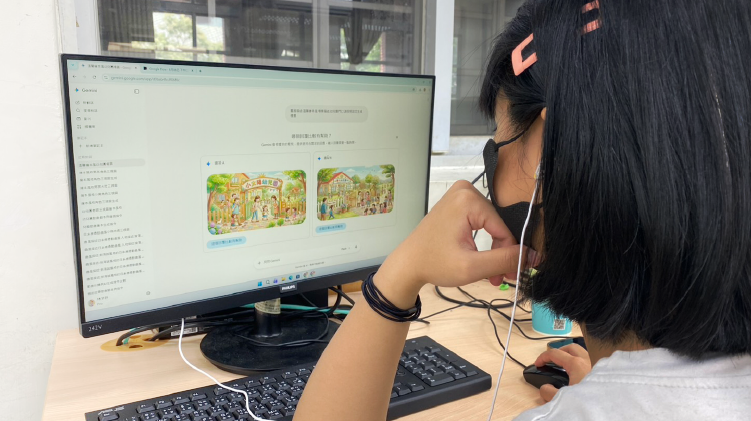
A: Fluency means the student is no longer just using AI — they are directing it. I know a student has reached this stage when they start critiquing the AI's output. They might notice that an AI-generated illustration has reversed a character's hands, or that a storyline is becoming repetitive. They then use voice commands to demand specific corrections. That's mastery — the student is using the tool to fulfill their own precise creative intent, not the other way around.
Q: How do these AI skills eventually translate into professional, real-world functions?
A: Predicting specific job titles is difficult given how rapidly AI is evolving. But I see these skills as foundational, the same way reading, writing, and digital skills are. Knowing how to use AI to record, discuss, refine, and achieve a goal is a fundamental work habit. Without AI literacy, students may lack any ability to even knock on the door of future professional opportunities, and that would be a shame because our students have so much to offer.
Case Study: A Comic of Inner Reconciliation
Q: Can you share a specific student story that illustrates AI's transformative potential?
A: One student stands out clearly. He has ADHD and significant emotional challenges, and he had always struggled to produce logical written text or clear visual art. He had ideas — vivid, complex ones — but he could never execute it on his own. Without AI, his creativity would have stayed at that 10% mark indefinitely.
Q: How did AI help this particular student organize and express his ideas?
A: I used ChatGPT's voice recording feature to hold a series of conversations with him. Rather than asking him to write anything, I simply talked with him — drawing out his thoughts, his favorite story tropes, his feelings. He was fascinated by "Isekai" (異世界) narratives, the Japanese genre where a protagonist travels to another world. Over eight sessions, we built a story together: a protagonist who travels back into his own memories to resolve emotional trauma from his past. AI recorded every session, organized the world-building details, and transformed his fragmented ideas into a structured script.
Q: What did the finished work reveal about him?
A: It surprised every teacher who read it. One chapter featured a "Raging Bull" as the antagonist — which clearly mirrored his own anger issues. But rather than simply defeating the bull through force, his protagonist devised a careful, rational process: administering a sleeping potion, then playing soothing music to calm the animal. He wasn't fighting his anger — he was managing it. The comic became a space where his problem-solving intelligence, often hidden by social friction in the real world, could finally be seen and acknowledged.
A New Definition of Ability
Q: Some worry that AI lowers the bar for students. How do you respond to that?
A: It's entirely a matter of perspective. For a high-achieving student, AI assistance might smooth their work down to something average. But for a special needs student who is operating below 20% of their potential due to access barriers, AI can lift them to 70%. New technology doesn't simply replace old skills — it creates new categories entirely. Think of it this way: when dumpling-making machines were invented, handmade dumplings didn't disappear. They became more precious. AI-assisted work and traditional skills will coexist, each valued for what it uniquely offers.
Q: Is the concept of "disability" itself being redefined in this context?
A: Absolutely. I have a student whose blunt, sharp criticism of others is a constant social obstacle for him — it creates friction everywhere he goes. But in the context of AI, that same trait becomes a rare competitive talent. He can identify flaws in AI output with surgical precision, demanding better results until the tool performs exactly as he envisions. What society labels a "disability" in social communication can, in the right environment, become a genuine professional advantage.
Q: What have you discovered about creativity when you remove the requirement for "standard expression"?
A: When we stop obsessing over perfect rhetoric or standardized formats, feeling and intent become more powerful than performance. AI dissolves the walls between disciplines — arts students can write code, and science students can express humanistic care. I have seen students use AI to create deeply moving literary works and emotional music videos that left audiences speechless. These students proved that creativity has never been the problem. Access was.
A Vision Built from the Ground Up
Lee Pin-Hsuan's approach reframes what it means to support special needs students in the modern age. Rather than lowering expectations or simplifying content, he uses AI to remove the barriers that have always stood between these students and their full potential.
His message to other educators is straightforward: stop looking at AI as a shortcut and start seeing it as a scaffold. Education, he insists, is an experiment — and in special education, the most important experiments begin by looking upward from the bottom, identifying where a child is being failed, and using every available tool to change that.
As AI continues to evolve, Lee's students are not being left behind. They are, in many ways, already ahead.