The AI-powered MT500 Matrix Tracking Box centralizes camera and audio control for large spaces, solving the limits of huddle room gear by automating multi‑camera switching, integrating beamforming microphones, and simplifying complex setups so IT teams can scale lecture halls, boardrooms, and campus deployments with faster rollout and consistent, broadcast-quality experiences.
Huddle rooms are excellent for streamlining small, fast meetings. But for the IT managers, system integrators, and consultants tasked with scaling up an organization’s needs, the move into complex, large-scale environments like tiered lecture halls, government chambers, or corporate boardrooms highlights the limitations of small-room equipment.
Large spaces introduce technical hurdles that basic huddleroom gear can’t handle. More surfaces and wider seating create stronger reflections, longer reverberation times, and uneven sound levels across the room1, so acoustic treatment plus distributed microphones/speakers and DSP/beamforming (rather than a single smallroom camera or mic) are required to preserve intelligibility and consistent coverage.
To understand the design philosophy for solving these large-scale challenges, we sat down with Kiki Xing, a Product Manager at AVer’s Pro AV Product Unit, to discuss how the MT500 Matrix Tracking Box acts as the central brain for complex setups.
The Gap Between Small Gear and Big Rooms
Most IT teams try to scale up by simply adding more of the same equipment. This rarely works in corporate or educational spaces with divisible rooms, training areas, and auditoriums. Large rooms suffer from technical drift, where audio lags or cameras fail to capture the right person at the right time.
“A big frustration we hear from IT managers is the need for a dedicated operator, especially in complex rooms like divisible rooms,” Kiki explains. “Before the MT500, a divisible room often needed a person just to switch camera angles. It was expensive and prone to human error; we wanted to offer a premium automated experience.”
She notes that this drive for automation stemmed from three key pain points common in large spaces:
- Static Architecture: Fixed room configurations lead to wasted real estate and "room-not-found" scheduling bottlenecks.
- Input Overload: Juggling disparate audio sources without a unified hub creates signal interference and high latency.
- Reactive Intelligence: Basic voice tracking is too slow to catch natural conversation, leaving remote participants feeling disconnected.
“We designed the MT500 based directly on feedback from users of our MT300 Matrix Tracking Box, who asked for an even more premium experience,” Kiki says. “The main requests were for a simple setup to handle divisible rooms like a 2-in-1 space with a single MT500 and, of course, to have more powerful AI. It’s also why we added support for advanced audio protocols like Dante®, which is a key differentiating factor between the MT500 and the MT300.”
A standard meeting hub might handle two or three cameras. The MT500 is built for a different category of work. It can register up to 25 IP stream inputs, which allows for total room coverage of advanced room layouts, such as those with non-traditional seating arrangements.
“People ask why someone would need 25 inputs,” says Kiki. “But think about a modern medical school, for example. You might need views of the professor, the students, an overhead view of a demonstration table, and three different static angles of the lab equipment. The MT500 can manage complex multiple views all at once.”
What’s more, it doesn’t just support multiple inputs but also processes them. It can display and switch between 11 concurrent sources. This includes 8 IP or USB streams and 3 HDMI inputs. And by using AVer’s IntelliSwitch feature, the system transitions between these views automatically.
The result is a high-quality broadcasting experience. Remote viewers are no longer looking at a tiny person in a giant room but rather the context and the content that matters.
Audio Integration and Voice Tracking for Large Spaces
Visuals are only as good as the audio that goes with them. In a large hall, sound is difficult to manage. High ceilings and reflective surfaces create echoes that can ruin a remote meeting.
To fix this, AVer works with premium microphone systems, including those from Audio-Technica, Biamp, Bosch, ClearOne, Nureva, Sennheiser, Shure, and Yamaha. With AVer’s built-in PTZ Link Premium software, the MT500 uses data from beamforming microphones to tell the cameras where to look.
“An AVer PTZ camera becomes a voice tracking camera, essentially eliminating audio blind spots,” says Kiki. “For instance, when a Bosch or ClearOne mic picks up a voice in a specific zone, the MT500 immediately knows which of the 25 cameras has the best angle. It happens in milliseconds.”
However, scaling an advanced ecosystem brings a major drawback: the setups themselves demand extensive manual effort and hours of painstaking coordination. Time spent setting up hardware, routing signals, tweaking software, and running tests adds up quickly.
To address this, Kiki points out that “the MT500’s InstaConfig feature was a direct response to feedback from IT staff. They don’t have three days to spend in every room. With InstaConfig, the system recognizes the audio hardware and applies the correct settings instantly.”
Growth and Cross-Location Management
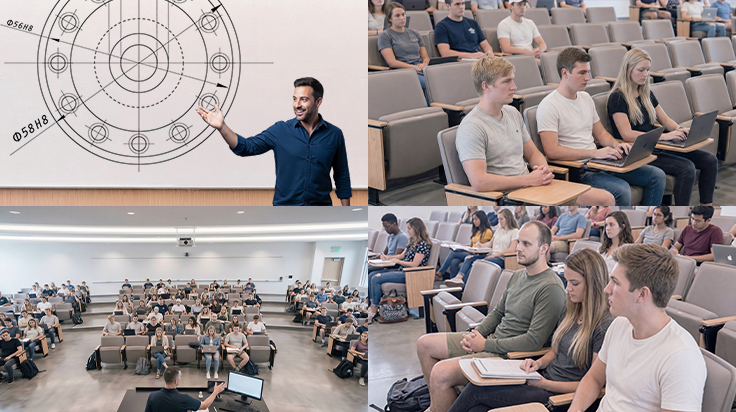
When an organization invests in the MT500, it is usually looking at expanding their conferencing capabilities in two ways.
According to Kiki, there are often two types of users. Across versatile environments, there are those who focus on a single, complex room and want to add as many angles as possible. Then there are users who manage many rooms across locations, such as an entire campus, from one central office.
For single, complex rooms, setup can be completed through the front panel or web UI for master configuration. For the management of multiple rooms, AVer’s web-based software suite, from Room Management to Enterprise and Cloud Management, provides vital, centralized control and allows IT managers to remotely monitor the health of every device across all rooms. This ensures minimal downtime in high-stakes environments, such as boardrooms and government chambers.
Professional Results Without the Production Crew
The goal of modern AV design is to make the technology invisible. When a presenter walks into a room, they should focus on their presentation or lecture, not the remote control.
A common thread in McKinsey’s2 commentary since the global pandemic has been that companies are investing more in attractive workspaces to offer a superior experience to what people have at home. The MT500 makes that experience manageable by taking the complexity of professional broadcasting and putting it into a box that just works.
“At the end of the day,” Kiki concludes, “we want all remote participants to a meeting, lecture or event to feel like they are in the front row. The MT500’s FaceFocus feature makes that possible by managing the scale that other systems simply can’t handle.”
Experience the MT500 in Action
Large-scale AV does not have to be a headache for your IT team. If you are ready to see how the MT500 can transform your most challenging spaces, our team is ready to show you.
Book a Live Demo Today
Frequently Asked Questions
What is the MT500?
The MT500 is a matrix tracking system that centralizes camera and audio control for large AV environments, automating multi camera switching, processing multiple inputs, and coordinating audio sources for consistent, broadcast-quality output.
Why isn’t huddle room gear sufficient for big venues?
Small room equipment is designed for short distances and low reverberation. Large rooms need distributed microphones, acoustic treatment, and multiple cameras to handle reflections, longer reverberation times, and uneven coverage.
How does audio integration improve camera tracking?
Beamforming and networked microphones provide precise audio location data to the MT500, which uses that information to select and switch to the optimal camera in milliseconds. This keeps the visuals aligned with the person who is actively speaking.
What scale of inputs and outputs does the MT500 support?
The MT500 can register up to 25 IP stream inputs and display up to 11 concurrent sources (typically 8 IP/USB streams plus 3 HDMI), enabling comprehensive coverage of complex room layouts.
How does the MT500 reduce setup and tuning time?
Features like InstaConfig automatically detect connected audio hardware and apply recommended settings, while centralized management tools enable IT teams to deploy and monitor configurations remotely, reducing the manual labor and time involved.
References
Boulemaredj, Ali, Dalal Farid, Amel Saifi, Hadj Ibri, and Mohamed Essedik Benotmane. “Room Acoustics of Conference Halls and Amphitheaters: A Literature Review on Architectural and Engineering Design for Speech Intelligibility.” Paper presented at the 1st National Seminar on Innovative Materials, Construction and Environment (NSIMCE‑2025), Skikda, Algeria, November 2025. ResearchGate. https://www.researchgate.net/publication/400961890RoomacousticsofConference
HallsandAmphitheatersALiteratureReviewonArchitecturalandEngineeringDesignfor
SpeechIntelligibility. ↑
The Future of the Office. https://www.mckinsey.com/industries/real-estate/our-insights/the-future-of-the-office ↑