Virtual nursing helps hospitals address nurse shortages and keep costs in check. Integrating Medical Grade PTZ Cameras into workflows offloads continuous monitoring from on-site staff to remote clinicians. This supports clear, continuous remote monitoring and features AI-powered fall detection, helping enhance patient safety and contribute to a more sustainable nursing work environment.
Addressing the Nursing Shortage: Why Virtual Nursing Matters
A big challenge for decision makers in medical facilities is how to provide consistent patient attention when bedside teams face increasing time pressures. McKinsey reports1 that the U.S. alone faces an estimated shortage of up to 400,000 nursing personnel by 2030.
What this staffing crisis means is that there are unsustainably high patient-to-nurse ratios and chronic burnout among medical staff, forcing hospital systems to rely on expensive traveling nurse contracts that drain financial resources.
For many medical institutions, the fix lies in the adoption of remote nurse monitoring. By using high-definition video cameras and specialized clinical workflows, hospitals can maintain a high standard of service even with limited on-site personnel. Telehealth nursing solutions are not just about managing a shortage of nursing staff but also about creating a more resilient, sustainable, and scalable system for modern medicine.
Virtual Nurses as Clinical Co-Pilots: Roles and Workflows
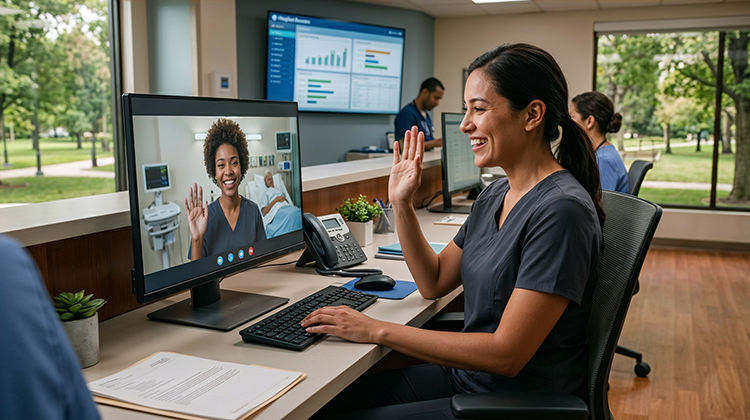
Virtual nursing is a collaborative care delivery model designed to support, not replace, the bedside team. By pairing bedside nurses and remote nursing staff (virtual nurse), hospitals build a more resilient way of doing things for the benefit of patients.
A virtual nurse can manage several high-impact responsibilities and workflows2 3, including:
- Streamlined Admissions and Discharges: Handling documentation required during patient transitions can often take up much of the time better spent on bedside duties.
- Continuous Patient Surveillance: Provide a constant presence, especially during shift handovers. This ensures no patient is left unmonitored during the ‘quiet’ minutes when the floor team is huddling to exchange information.
- Clinical Mentorship: Enable experienced nurses to remotely guide less-experienced staff through more complex procedures. This is vital for hospitals that have a significant proportion of newly practicing nurses.
What’s more, virtual nursing is also particularly effective at bridging borders4. It allows rural or under-resourced hospitals to access specialized expertise remotely, so small community clinics can receive oversight from specialists at larger urban medical centers.
Virtual Nursing Benefits: Where Tech Meets Touch
Lower Nurse Turnover
Integrating virtual care into daily workflows can help reduce workloads. For instance, while a bedside nurse handles a physical task like changing an IV, a remote partner updates the Electronic Health Records (EHR) in real time, improving coverage and reducing the admin burden that often leads to exhaustion and errors.
So when nurses feel supported instead of overwhelmed, they feel engaged and find meaningful connection to their work and are more likely to stay in their roles5. With lower turnover rates, hospitals can boost return on investment (ROI) by avoiding the heavy financial burden of recruiting and training new employees.
Fall Risk Reduction Through Remote Visual Monitoring
Beyond staff retention, the safety benefits are quantifiable. A 2024 study highlighted that remote visual monitoring can lead to a 39% reduction in patient falls with injury6. This is achieved through proactive observation. In virtual nursing models, a virtual nurse can identify early signs of patient movement or unsafe attempts to stand and use a two-way audio system to provide verbal redirection while alerting the floor team as needed. While not all falls can be prevented, in the event a patient falls out of bed, Medical Grade Cameras use AI fall-detection features to send immediate alerts to nursing personnel.
A Better Experience for Patients
As virtual nurses are not physically rushing between wards, they can perform more thorough, unhurried rounding. Patients often report higher satisfaction scores because the virtual nurse has the time to listen to concerns without one foot out the door.7
Camera Quality Enhances Clinical Confidence
Some surveys8 on clinicians’ responses about the usefulness of virtual nursing show that it can have mixed results, however, especially when the technology is applied without carefully matching the specific demands of the patient population and the expertise of the bedside team.
As such, high-quality care depends on a well-designed virtual nursing model, supported by reliable technology. Within this framework, high-quality equipment with clear camera resolution, optical zoom, and dependable audio-visual connectivity plays a critical supporting role in enabling effective remote collaboration.
Low-quality video or limited camera functions can hinder a clinician’s ability to conduct clear remote visual observation. Unsurprisingly, medical teams generally only view virtual assessments as equal to in-person care when they have access to high-fidelity video and a dependable connection.9
Medical Grade Cameras for Hospitals Support Reliable Remote Monitoring
For a virtual nursing program to be successful, the ‘eyes’ of the system must provide reliable visual clarity. Medical Grade PTZ (Pan Tilt Zoom) Cameras are specifically engineered for these demanding environments. To ensure safe and reliable operation in medical settings, the hardware should comply with IEC 60601-1-2 medical certification, which defines electromagnetic compatibility requirements for use in medical environments.
With professional-grade imaging, virtual nurses can remotely monitor:
- Early Visual Cues: High-resolution imaging can help a virtual nurse look out for visual abnormalities and notify on-site staff for further evaluation.
- Medication Verification: Zoom in to confirm IV drip rates and medication labels on bedside pumps. This double-checking system supports safety protocols to prevent medication errors.
- Equipment Data: Read ventilator settings and vital sign monitors from a distance. High optical zoom allows the camera to read small text on medical screens, providing the remote nurse with the exact same data as the person standing in the room.
Patient Privacy and Data Security
AVer Medical Grade PTZ Cameras are also designed with secure encryption and privacy features in mind, which is vital for maintaining patient trust. This includes physically turning off the transmission of the audio and video feed or automatically detecting and applying a mosaic effect to bodies or faces within the field of view.
Scalability with Centralized Software
Furthermore, a camera solution should be built for scalability. With AVer’s ViewCare software, for instance, a single virtual nurse can manage up to 256 cameras. This makes for a sustainable solution for large healthcare networks looking to centralize their monitoring operations.
With virtual nursing, hospitals can achieve better ROI through improved clinical outcomes and stabilized staffing. The cost of a single fall or a single nurse resigning can often outweigh the investment in high-quality virtual nursing hardware. Patients receive extended care coverage, while nurses gain the professional support required to remain in the field and provide the best possible care.
To see how Medical Grade Cameras can enhance your facility’s safety standards and support your nursing staff, explore AVer Connected Health Solutions.
Frequently Asked Questions
Does virtual nursing replace bedside staff?
No. It acts as a second pair of eyes to monitor patients. This allows bedside nurses to focus on physical care and patient interaction.
How do Medical Grade PTZ Cameras improve patient safety?
They provide high-resolution and high optical zoom to help virtual nurses verify patient details, observe changes, and alert on-site personnel for follow-up.
What is the benefit of IEC 60601-1-2 certification?
This certification shows that Medical Grade Cameras can work safely and reliably in real-world electromagnetic environments, helping to reduce the risk of interference with other sensitive equipment. Such attributes are important for devices used all the time near patients.
Is the system scalable for large hospital networks?
Yes. Specialized software such as AVer’s ViewCare enables a single operator to manage hundreds of camera feeds efficiently across multiple wards or even across different hospital campuses.
References
“Nurse managers: The backbone of a strong nursing workforce.” McKinsey & Company, May 6, 2025. https://www.mckinsey.com/industries/healthcare/our-insights/nurse-managers-the-backbone-of-a-strong-nursing-workforce. ↑
Roberson, Amy E, Holly R Martinez, Samantha A Holligan, and Marny Carlson. “An Evolving Virtual Nursing Model: Enhancing Care Delivery Through Advanced Workflow Integration.” Nursing Outlook 73, no. 3 (April 18, 2025): 102421. https://doi.org/10.1016/j.outlook.2025.102421. ↑
Fleming, Kathryn, Marie Foley-Daneker, Linda Walsh, Kathy Martin, Victoria Berner, and Pam Egnatovich. “Enhancing Patient Care Through Virtual Nursing.” Nurse Leader 23, no. 5 (June 5, 2025): 102436. https://doi.org/10.1016/j.mnl.2025.05.002. ↑
Apple Podcasts. “Bridging Borders: Bringing Virtual Nursing Across the Globe,” October 21, 2025. https://podcasts.apple.com/tw/podcast/bridging-borders-bringing-virtual-nursing-across-the/id1733686600?i=1000732816743&l=en-GB. ↑
“The State of Nursing Turnover and Key Nurse Retention Strategies.” 2023. November 29, 2023. https://info.pressganey.com/press-ganey-blog-healthcare-experience-insights/the-state-of-nursing-turnover-and-key-nurse-retention-strategies. ↑
Ergai, Awatef, LeeAnna Spiva, Susan Thurman, Marianne Hatfield, Meriel McCollum, and Mona Holmes. 2023. “The Effectiveness of Remote Video Monitoring on Fall Prevention and Nurses’ Acceptance.” Journal of Nursing Care Quality 39 (1): 24–30. https://doi.org/10.1097/ncq.0000000000000716. ↑
Tyransky, Cassandra E., Kasey Paulus, Erin Langmead, David M. Miller, Carol R. Smith, Fallon Hughes, Barbara L. Buchko, and Bruno Saconi. 2025. “Integration of Virtual Technology and Artificial Intelligence Improves Satisfaction, Patient Safety, and Nursing Workforce Efficiency.” Journal of Nursing Care Quality 40 (3): 193–201. https://doi.org/10.1097/ncq.0000000000000842. ↑
Muir, K. Jane, Alexandra Maye, Matthew D. McHugh, Linda H. Aiken, Vicky Vo, and Karen B. Lasater. 2025. “Virtual Nursing for the Care of Hospitalized Patients.” JAMA Network Open 8 (12): e2545597. https://doi.org/10.1001/jamanetworkopen.2025.45597. ↑
Snoswell CL, Chelberg G, De Guzman KR, et al. The clinical effectiveness of telehealth: A systematic review of meta-analyses from 2010 to 2019. Journal of Telemedicine and Telecare. 2021;29(9):669-684. doi:10.1177/1357633X211022907 ↑